Subscribe to Our Podcast

SQUAWKING DEAD Podcast Links


Become a Patron!

Listen to the latest SQUAWKING DEAD Episode!

⬇⬇⬇Listen to the most recent episode!⬇⬇⬇


Why miss out? Subscribe to our blog via E-Mail!

Monday, October 23, 2023

#TWD @ New York Comic Con (2023)

Why miss out?
Subscribe to our blog via E-Mail!

⬇️Listen Now⬇️

⬆️Tap the above graphic⬆️
to listen to this episode
in your favorite Podcasts App


Surprise! We LIVESTREAMED all #TWDUniverse news coming out of New York Comic Con! Bridget was on site while Dave reported on what was happening and received your reactions. The Spotify video  podcast and (general) audio podcast contains the condensed version of that livestream for your audible enjoyment!
Do not miss an opportunity to be with us in the chat the next time we go live! Tap here to subscribe to our YouTube channel and be sure to enable ALL notifications: it's one of the least expensive ways to support us and ensures you don't miss a thing!

David Cameo:
Bridget Mason-Gray:

πŸŽ–SURVIVORS TIER MEMBERS:
Takeerah:

  • First thing's first, it should be known that we were able to watch The Walking Dead: Daryl Dixon panel at New York Comic Con for free on Popverse thanks to Tumblr (it's available on-demand for Popverse members); however, both TWD: Daryl Dixon's season finale and all trailers/teasers for The Walking Dead: The Ones Who Live, Orphan Black: Echoes, and even Fear The Walking Dead were not available to watch via the stream (but don't worry, read on because we've embedded them here).

  • Here is the teaser for Orphan Black: Echoes, featuring lead-actress, Krysten Ritter.
  • Here is the teaser for The Walking Dead: The Ones Who Live, featuring Andrew Lincoln (as Rick Grimes) and Danai Gurira (as Michonne).
  • We also mention the brand new art concept design in our merch store store reflecting our discussions on TWD: Daryl Dixon that says L'espoir est Perdue (Hope is Lost) featuring a walker Daryl Dixon being guided by Carol Peletier through the desert.

  • It is then announced that the general release date for TWD: The Ones Who Live is February 2024.

  • It should also be known that, in light of the combined Screen Actors Guild of America and Writers Guild of America strikes, Norman Reedus was only able to attend due to his role as Executive Producer as a result of the deal they made with with AMC.
  • Here are the promo stills that were mentioned, provided by Insider's Kirsten Acuna, of Michonne and Rick on TWD: TOWL.
  • New cast announced for TWD:TOWL -- Major General Beale (mentioned in The Walking Dead: World Beyond) will be played by Terry O'Quinn; Matthew August Jeffers will be playing Nat; Leslie-Ann Brandt will be playing Pearl Thorne. Returning cast-member from both The Walking Dead and World Beyond, Pollyanna McIntosh, will be reprising her role as Warrant Officer Anne "Jadis" Stokes.
  • Some viewers of both TWD:TOWL teasers noticed it appears as though Rick may have chopped off his hand (which would be a nod to the comic book).
  • The sneak peek to FearTWD is played and features a scene with Colman Domingo (as Victor Strand) and Kim Dickens (as Madison Clark).
  • In the midst of the actual panel conversation, which we've summarized below (read on), everyone in attendance is presented with the teaser for Season Two of what will now be called (to the consternation of everyone present in our livestream):
    The Walking Dead: Daryl Dixon -- The Book of Carol.
  • We did, in fact, livestream our coverage of TWD: Daryl Dixon's season finale (something we mentioned we'd do during this livestream, which you can watch or listen to, here:


  • It appears as though Danay Garcia (who plays Luciana Galvez) will be directing, for the very first time in this series, the mideason premiere of FearTWD.

  • The panel livestream finally resumes after the audience is finally finished watching TWD: Daryl Dixon's season one finale and all the teasers that were introduced. Panel Moderator and Entertainment Weekly writer, Dalton Ross, introduces the creative team of the Daryl Dixon spin-off: Scott Gimple, David Zabel, Greg Nicotero, and Norman Reedus
    Editor's Note: as mentioned in our previous blog, the remaining descriptions have been generated with the assistance of A.I. language models that summarized the transcript from our livestream and is being minimally tweaked by your favorite human, Dave.
    • Norman Reedus is asked about the final scene with Melissa McBride, who will be a series regular for season two.
    • Daryl Dixon is faces a pivotal choice between coming home and staying with his French family. The central premise of the series is about finding home and belonging. Daryl is forming bonds and connections against his own will.
    • Season one of the show is different from the original series in terms of location, look, and music. The mission was to maintain the standards of The Walking Dead while broadening the scope. Being in France was a way to shake things up in the expanding universe of TWD. Actors and crewmembers were excited about the new setting and storyline. There were challenges in figuring out how to incorporate Daryl's character into the new environment, such as ditching his usual look with wearing a scarf and suspenders. The wardrobe, cinematography, and overall feel of the show in France were different from TWD.
    • The cast and crew in France were enthusiastic and dedicated to the show, which showed in the quality of their work. The fans in France were excited to be on set and interact with the zombies. The language barrier added an interesting element to the story, with Daryl trying to understand body language and communicate with the French characters. Filming in France allowed for a unique juxtaposition of culture and history against the backdrop of the apocalypse, which was way different from the set in Georgia due to the unique locations which allow for different storytelling opportunities.
    • The show aims to be both funny and emotionally impactful. The setting of France adds a specific and evocative atmosphere to the show. The production team took big risks and wanted to make the show feel fresh and original. The show received positive feedback for its originality and hard work. There were concerns about taking the show to France, but the cast and crew were on board. Norman Reedus played a key role in keeping the focus on shooting in France. Shooting in France was a significant step forward for the show's universe. The cast and crew wanted to do something completely different and out of their comfort zone.
    • The possibility of shooting in other locations were discussed, such as (jokingly) Costa Rica. Mont Saint Michel was kept in mind for shooting, but they never thought it would actually happen! Getting permits for shooting locations involves pitching the best version of the idea and sometimes not being able to fully achieve it. Obtaining locations in France, specifically Mont Saint Michel, required a lot of work and involved meeting with local officials. The selling point of increased tourism did not convince officials, as they felt they already had enough tourism. The experience was completely different from when they were just trying to film inside convenience stores in Georgia.
    • The appearance of the zombies on the show was designed to keep them scary and thrilling. Different zombies were created: burners, with their visible veins, and the amped-up variety, which completed their ferocious look with black contact lenses. Attention to detail was given to the latter's appearance, including the filing down of their teeth to sharp points. The design of the zombies is not just for visual appeal, but also plays a role in advancing the story. Building puppets and creating special visual effects makeup for the zombies was a fun and creative process and ensures the desired impact on the audience, in order to keep them engaged.
    • Director David Zabel was new to the universe and was constantly amazed by the scenes in the show. The goal was to make the walkers a real threat in a new and different way, while making each sequence matter, narratively speaking. Zabel also revealed that a second unit was established for the zombie scenes, directed by an (uncredited) Greg Nicotero, as he knew how to handle them. Nicotero will also be directing in Season 2.
    • Norman mentions how unique of an experience it is to be able to play the same character in a completely new world. Working with new castmembers allowed him to stretch different acting muscles. The first scene filmed of the first episode involved a big fist fight with Romain Levi (who played StΓ©phane Codron), which made his character feel scarier. Norman was also interested in exploring moments where his character didn't appear to have everything under control and wanted to keep Daryl as the kind of hero who doesn't know that he is a hero.
    • All the characters on the show have their moments to shine throughout the season. Season 2 will further develop and evolve the characters. The actors and the crew, including the zombie performers, were amazing. The show wanted to go back to the feel of the first season of The Walking Dead with a small group of core characters. The little moments between Norman and ClΓ©mence PoΓ©sy (who played Isabelle Carriere) in the last episodes were powerful and impactful.
    • Daniel Percival set the tone for the show and helped create its visual style. There is interconnectivity between the different Walking Dead shows happening in different cities and countries. The show has a mythology and backstory that will be explored further.
    • A question from the audience was asked about the toughest and most rewarding scenes that Norman filmed: Norman mentions the scene with co-star, Louis Puech Scigliuzzi (who played Laurent), in which he yells at him after cutting the boat loose. He also had fun filming scenes where he was beaten up. While Norman is enjoying his role on the show, he is also learning about himself and the production process as an executive producer, through attending tech scouts and zoom meetings.
    • Another audience member asks about whether he would consider cutting his hair, since Daryl's hair grew throughout the his time in The Walking Dead Universe and that it became a part of his character. Norman mentions that it was discussed, including the tragedy that befell the series Felicity and how cutting off the main character's signature curly locks caused much controversy. Norman even considered cutting his hair in Season 4 of TWD, but decided against it. Plus, his long hair looks much cooler when smattered in blood.
    • Another audience member spends his time on the mic thanking Norman for advocating against getting their cat declawed and even recommended a vet he should go to. Unfortunately, this took a lot of time to get through (to the annoyance of all in attendance) and Dalton stepped in to help him along.
    • Another question is asked about the possibility of a sequel to The Walking Dead series. Chief Content Officer, Scott Gimple, describes the possibility of TWDU converging in a narrative way.
    • Another audience member asks about a Daryl's decision (between home and home) in the season finale. Norman mentions how Daryl wouldn't be able to leave Laurent behind, whether or not walkers present.
    • The next audience question is for Norman, as well: how has it felt about growing with Daryl all these years. Norman reflects on his experience in television and being recognized by viewers. He's loved his character's development and growth on the show, learning from other characters like Rick and Hershel Greene. It's always been a joy playing Daryl and, unlike many of his castmates, he has no desire or plans to abdicate his beloved role. He acknowledges the excitement from fans and expresses gratitude for their support.
    • This is the point at which the exclusive teaser for Season 2 plays, which (again) was not able to be viewed through the livestream and embedded earlier. What only audience members in attendance received (over folks just watching the teaser, post factum) is a special pre-amble by Melissa McBride.

⭐⭐🌟Like What We Do? Buy Us a Coffee!🌟⭐⭐

Monday, October 16, 2023

Deux Amours |1x05| The Walking Dead: Daryl Dixon

Why miss out?
Subscribe to our blog via E-Mail!

⬇️Listen Now⬇️

⬆️Tap the above graphic⬆️
to listen to this episode
in your favorite Podcasts App


Enter into a covenant with us by following us or subscribing to our content as we witness a whole new dimension of Daryl Dixon that had us "shooketh". Quinn is gross... maybe. RIP Azlan: you were endearing... definitely. And, wuh oh, that walker is the most dangerous variant we've seen in #twduniverse...
πŸ›‘STOP LISTENING! STREAM the unedited version of this podcast, instead! Buying us a ☕coffee on Ko-fi or joining a membership on either Patreon or Ko-fi will grant you immediate access to the uncut version of this video, past sessions, and future unedited episode recordings!

David Cameo:
Sherrandy Swift:
Bridget Mason-Gray:

πŸŽ–SURVIVORS TIER MEMBERS:
Takeerah:

The Blog is devolving

We radically upped our blog game when we brought on Aidan Atkin to write our blogs sometime around our coverage of Better Call Saul's final season. The visual and descriptive format was pretty stellar and, after adopting it, it was hard to imagine doing it any other way or ever going back; however, for the hours and hours of work that goes into every individual blog, to make them coherent and worthy of a read, we're only receiving 5% of the traffic we were typically receiving per blog only a few years ago. So what's the point of being so literary? One could and often does simply listen to or watch the episode over reading it, anyway.

We welcome your feedback in the comments and always have (so change our minds, please) but, from this point forward, we're only going to be including reference and bonus materials along with a general outline generated by AI that's only lightly tweaked. This is the best we can do without making ourselves crazy. We all have day-jobs: most of us are living paycheck-to-paycheck. This podcast barely pays for itself, but it's the time that we put into it that we'll never get back (that costs more than money can afford). It breaks our heart to have to give you less after striving to always give you more, but sometimes a promise - even the kind you make only to yourself - isn't worth keeping if you're suffering too much in order to keep it.
  • The episode title Deux Amours means two loves, referencing the song (J'ai Deux Amours, sung in this episode) by Josephine Baker (lyrics).
  • Check out our new SQUAWKING Dixon art design of Carol Peletier dragging a zombified Daryl Dixon through the desert. The tagline translates to Hope is Lost.

  • The episode is dense with lots of material, references, and Easter eggs. Some had fears that this season wouldn't cap-off nicely, but we're enjoying it so far. Spoilers abound on social media for Season 2 already, which some of us have unfortunately seen.
  • Julian Canon mentioned that this episode is the best of the season. Some of us disagree with that, but also believe that the suspense built throughout the season was an example of good writing. We also enjoyed seeing Daryl on his own, again, and appreciate the many dimensions his character has. Many fans have forgotten who Daryl is and have criticized his actions in this series. Dave feels that this episode showed a new dimension to Daryl's character. We had a strong reaction to a particular moment in the episode, but enjoyed the more classic motifs typically found on The Walking Dead.
  • Bridget is vindicated: she had said that the silhouette chasing Daryl on the boat in the teaser was a variant walker, despite others doubting it. Dave compares this to seeing a similar thing in the teaser to The Walking Dead: Dead City and how the actually bloody human attempting to flee The Croat by way of parkour was not a variant. Dave also jokes about potentially gaining more followers by saying he would unalive the president.

  • Sherrandy thought the boat scenes were unnecessary and could have been explained instead. She was aware it was meant to parallel the present-day storyline and explain how Daryl crossing the Atlantic Ocean. Dave thought an interesting contrast could be made to the way the writers were basically explaining the plot via poor dialog in Fear The Walking Dead's 8th season and how The Walking Dead: Daryl Dixon did the exact opposite thing. Some scenes may be considered filler, but there's an argument that the show has been consistent in showing not telling everything as it happens. Sherrandy disliked Quinn's interactions with Isabelle, finding them icky and even boring. She was really psyched about the possibility of Morgan Jones / Rick Grimes / Dwight / Heath coming back (by way of Daryl's brief radio conversation with Carol. Daryl's presence in Maine surprises us, as some of us expected him to go south or west (given what he said to RJ Gaines in Alouette). Maine also feels it may be Heath because of Tales of The Walking Dead's 5th episode, Davon, and how it both takes place in an Acadian village in Maine and Davon finds a PPP card after killing someone.


  • The French scientist is using his time at sea to conduct as much research as possible on the way to Le Havre port in France. While panning across the deck, notice that there are two control groups of walkers: one to feed and one to fast, to test their reactions to stimuli. The possibility of weaponizing walkers is raised, and it is questioned if they are trying to get rid of them or make them more aggressive super-soldiers.

  • Genet says they gave them this plague, but later on in her speech refers to the undead as their cure: to fight against the oppressive, powerful elites. Pouvoir Des Vivants means Power to the Living: the meek have inherited the Earth and, therefore, are meek no longer. There's little uncertainty regarding Genet's intentions and her trustworthiness. Sherrandy even says it's possible Genet was involved in developing or disseminating the walker virus, in order to take power from the elites. Dave, yet again, draws parallels between Genet's words, the French Revolution, and Nazi Germany. Sherrandy is triggered by Genet establishing The Sixth Republic, which allows Dave to explain to the audience the significance of Charles de Gaulle and how he helped establish The Fifth Republic of France.

  • Genet's dialogue - in the scene where she, Isabelle, and Laurent are present - is word for word lifted from the late 1970s version of The Incredible Hulk, Don't make me angry. You wouldn't like me when I'm angry. Bridget jokes that she does this because pop culture references can be used to sound cool, again, especially in the context of an apocalypse. Sherrandy mentions how Bruce Willis' character in Die Hard lifted Yippie Kai Yay from Roy Rogers.

  • Takeerah asks whether Isabelle and her order of nuns were vegetarian. Due to sustainability or lack of access to other types of protein, it's quite possible. In a post-apocalyptic world, resources like food are scarce and people have to rely on what they can grow or find. Sherrandy says that Isabelle, having been a city girl, probably lacked hunting experience or the ability towards self-sustainability. They likely obtained most of their supplies from the outside world before the apocalypse. They probably didn't want to contribute to more death and were not prepared to hunt or dress animals. Raising Laurent to value life and not be hypocritical also means not killing animals for food. The concept of Lent is brought up: a time when Catholics give up something impactful to reflect Jesus' sacrifice for them. Fish is often eaten during Lent because it is not considered meat in Catholicism. Laurent's vegetarianism may have just been a grander covenant with God to never take a life. It also explains why the nuns are reluctant to kill walkers because they believe there is still a possibility of bringing them back to life. Valuing life means not killing animals for food and setting an example for others. Dave discusses the possibility that The Nest's spiritual leader - and that of The Union of Hope, is a Tibetan Buddhist monk who also likely follows a vegetarian or even vegan diet. Going back to how sad we were at Azlan's passing, he mentions that eating animals is allowed as long as it is the only option available (and there's a doubt as to whether survival is possible without it), drawing parallels to similar guidelines in Islam and Judaism. Speaking of Judaism, it's also possible that Laurent is a Nazir: when one makes a personal covenant with God to temporarily abstain from cutting their hair and refrain from drink.

  • The discussion shifts to the escape plan of Daryl and Juno, noting that they were kept alive simply to feed the walkers in the feed control group. The humans in the adjoining cells may have starved to death to provide even fresher walkers for experimentation. There is curiosity about why walkers need to be brought from the US to Europe and whether there are differences in their behavior based on geography: after all, why not bring them from neighboring countries, like Germany or Great Britain? Sherrandy speculates that the variants of the virus may have originated in France, based on the final episode of The Walking Dead: World Beyond. Dave also compares this to The Nazis experimenting on Jews, rather than "Real Germans", suggesting that (Undead) Americans may be their preferred test subjects (rather than their own [un]dead). Sherrandy thinks that the amount of viral load in different countries may vary, potentially influencing the decision of choosing American Walkers for their experiments.

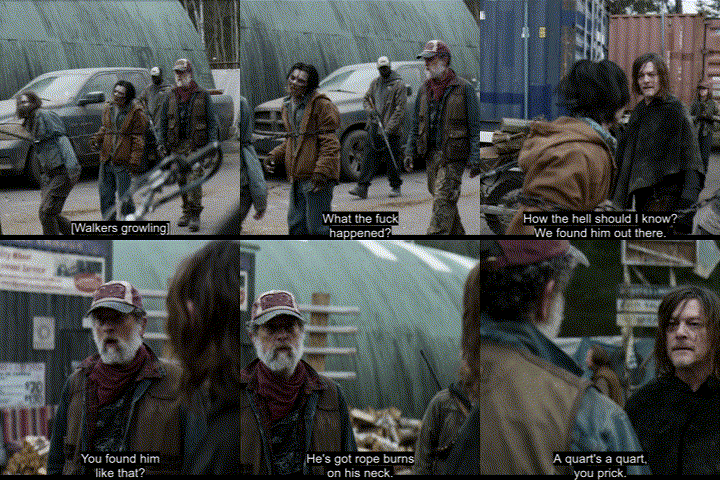
  • Then there's the height limit imposed on the gathering of walkers for experimentation and Sherrandy suggests it may be to avoid picking up individuals with dwarfism (AKA, undesireables) or, what Dave says, having these brutes kill actual children in their pursuit to receive more ethanol for their troubles. This brings us to whether the wood-chopping young man was killed by Juno and his crew, considering the presence of rope burns around his neck. Dave brings forth the possibility that he may have chosen to hang himself based on his dismal conversation with Daryl about going to (an obviously unsafe) California. Everyone else thinks that Juno and crew absolutely did kill the young man. Bridget adds that the kid lied about losing a bunch of walkers and may not have actually gone hunting, which brings up a bigger point about how he acts like many other children we've seen who are not well-prepared for survival. This only emboldens Dave's claim since, as a result of his conversation with Daryl, he may have realized no place was safe for he and his girlfriend. There is speculation that someone else may have influenced the kid to kill himself, too.

  • Bridget mentions that, yet again, Daryl let his temper get the best of him by striking Juno when he suspects he and his group of foul play, similar to when he struck Negan when we first meet him. Daryl's inability to follow the rule of no fighting lead to negative consequences. Dave makes a distinction: Daryl punches Juno not out of a sense of justice, but regret over not having done more to protect a clearly vulnerable kid amidst a brutal world.

  • This brings us to Laurent wanting Daryl to finally tell him about the people he misses. Where Daryl decides to place of Connie and Carol in his spiel to Lauren sparks animated discussion among us: some lady Carol being mentioned at the end says a lot, after all (you obviously have to leave the best for last). Speaking of romantic undertones, though they were completely absent during Daryl and Carol's conversation over the radio, they were definitely present when Laurent was trying to assert that Daryl misses Isabelle in the same way as he does his friends (Daryl attempting to completely ignore him all but confirms it). Dave also acknowledges that people take these discussions way too seriously, even those who they claim not to like shipping characters.

  • Going back to Azlan, one of the deeper conversations we had revolves around he and Daryl's discussion on promises being overwhelmed by a connection to others or to a larger cause. This is obviously imported to the larger argument over whether Daryl ought to be back with his original found-family or exploring new stories with his new found-family. The message this conveys to the audience is that sometimes a promise cannot be kept due to circumstances that overwhelm their capacity to keep it and developing connections to other people: Rick's promise to walkie Morgan at dawn; Lori's promise to Carl that he would beat this world; Eugene coming clean about not knowing a cure - choosing to bond with his found-family over self-preservation.

  • Daryl's response to Azlan: fathers join larger causes and never really return to their children - those who physically return only end up passing down their brokenness to their children, who later pass their brokenness down to their offspring. Takeerah mentions how the watch Azlan spent time fixing reminded her of Hershel Greene's pocket watch, which was later given to Glenn Rhee, who (touching upon Daryl's statement to Azlan) died before he got to see his son. Dave thinks that this might be a greater response to those who desire a zombie apocalypse as a form of escapism: forming factions in a post-apocalyptic world and doing unspeakable things passes deep trauma onto future generations and is not to be taken lightly. This parallels neatly to the present conflict in the Middle East and the blood feud between The Hatfields and McCoys: the cycle of violence can escalate without generations further down the line ever remembering the initial cause. Religion, in and of itself, has been the cause of major catastrophe: people are often swept up in crusades and caliphates, which leads them to break their promises in the process. Going back to what Azlan says though, sometimes choosing to keep a promise can diminish one's own life or cause them to needlessly suffer, which opens the floor to storytime with our hosts. Daryl, who apologizes later on in the episode for failing to deliver Laurent to The Nest (something that wasn't his fault), spent years chasing after Rick and hasn't really ever lived for himself since we've known him.

  • This conversation about causes and fathers - a connection between learned behavior and generational patterns - helps us to further understand the moment when Daryl blows up at Laurent for cutting their boat loose. Dave starts by sharing a personal experience with uncontrollable anger and temper: learned behavior from his father. Bridget mentions her own cyclical melodrama and regret between she and her father, resulting in difficulty controlling her anger. Daryl's father must've verbally abused him and called him worthless, not to mention this was the same words Juno is heard saying about the young man as he walks away to chop firewood for them. Daryl also sees signs that Laurent is trying to be (strong) like him. Daryl must've felt heartbroken when Laurent asks to stay with him and promises to do anything he says. Daryl realizes he has broken promises to both Isabelle and Carol and feels like, with the boat having long since drifted away, everything has fallen apart. Daryl's regret over not taking in the wood-chopping kid transfers to how badly he feels the need to keep Laurent safe. So when Laurent mentions that Isabelle is gone and, when they reach the nest, Daryl will be gone, Daryl is immediately thrown out of his angry state. It might've also reminded him of his conversation with Judith over whether she should tell him why Michonne was leaving.

  • The aftermath of Azlan's failed struggle with invading walkers is shown through visual storytelling. Azlan takes his passing in stride and sees the cosmic humor in it, but also believes he has fulfilled his part in furthering a Union of Hope and can go home now. With that, he recites a verse from the Quran, commonly used by Muslims in trying times or upon hearing of someone's passing. Azlan's prayer/meditation beads, similar to the Rosary in Christianity, are placed on top of his burial mound. Just like he was the one who initiated the Nanu-Nanu at Madame Dubois' funeral, he also softly whispered a Ma'a Salaam, which translates to peace be with you.

  • Azlan compares Daryl's journey through France to Abraham's journey from his father's lands to the land of Canaan. This further suggests that, like God promised Abraham in their own covenant, Daryl's new home may be France for quite some time. Bridget expresses her dislike for the idea of Daryl permanently changing his address. This does allow her to address her own living situation and how, ultimately, home is where her heart is.
  • This neatly dovetails to the other story of Abraham that's mentioned in this episode: The Binding of Isaac. Much in the way Abraham is unwaveringly prepared to sacrifice his son, so too does Dave believe that Quinn is knowingly leaving his life in Isabelle's hands in order to redeem himself in her eyes. Everyone else seems to regard this as a masterful manipulation. Bridget also criticizes Quinn for not being honest with Anna Valery and for not taking responsibility for his (in)actions towards her. Though Dave, too, dislikes Quinn based on his own life experiences, he appreciates the layered meaning behind the Abraham and Isaac reference, suggesting that it represents Quinn's willingness to sacrifice his own son, Laurent, for Isabelle's cause. Takeerah mentions that it could just be love-bombing: narcissists will use anything, including religion, to convince someone to break their covenant with God and make one with them. Dave says that it's less about love than the idea of worship and how some individuals may put their partner on a pedestal as a reflection of themselves or their desired status.

  • Takeerah shifts to criticizing Genet and her dangerous ideals, comparing it to the French Revolution and their mistrust and downright persecution of the church. After (rightly) accusing Quinn of giving a pot de vin (pot of wine = bribe) to one of her soldiers, he is promptly thrown in a cell with Daryl. Dave sees this as even more evidence of Quinn's attempt to get in Isabelle's good graces, since he knew the dangers of deceiving Genet, knew that he would need Laurent as leverage to get Isabelle to stay (if he were trying to manipulate her), and definitely would've loved to have gotten revenge against Daryl for the beatdown he received in the last episode. It might not make him a good person, but both things can be true.

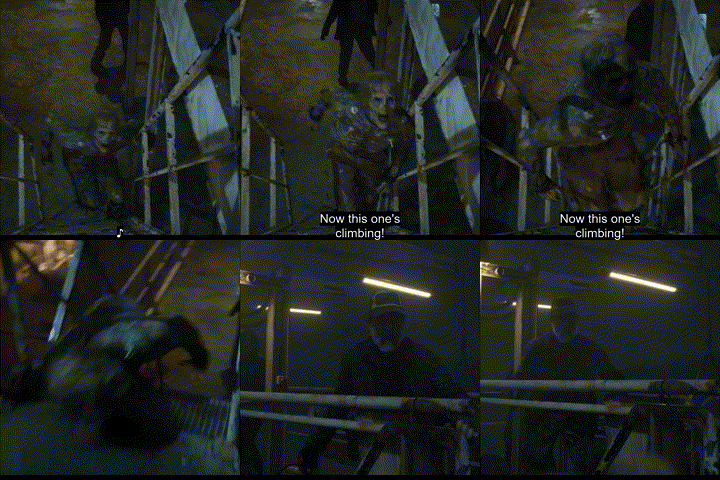
  • The conversation shifts to the topic of variants and their origins. We see two versions of this variety: one let loose on Daryl and Juno on the freighter and the one being brought out to waste Daryl, in the auditorium. Though smart walkers exist on The Walking Dead, the one we see on the freighter reminded Sherrandy of how frightening it was to see the Daleks climb stairs for the first time on Doctor Who. The walker on the freighter looked particularly gnarly, which made his swift movements feel that much scarier. What strikes us as particularly alarming is whether the aggressive walker in the arena might also be a burner: because that would not only be potentially deadly for even Daryl, it would also confirm that burners, too, were manufactured in a lab. Going back to The Incredible Hulk reference, the aggressive walker is wearing a green jumpsuit and is particularly enraged: maybe it's also wearing purple frayed shorts underneath?

  • As far as the way these aggressive walkers move, given how a normal the brain controls various functions, it's natural for a walker brain to be clumsy and not super capable since only a tiny portion of a walker brain is lit up. These aggressive walkers might have access to the neocortex, which is responsible for learned behavior and muscle memory, making their movements much more swift, precise, and coordinated: much like the zombies from World War Z. These aggressive variants love tearing their prey open before feeding on them, much like the one that tore open Juno like a lobster tail.

⭐⭐🌟Like What We Do? Buy Us a Coffee!🌟⭐⭐