Subscribe to Our Podcast

SQUAWKING DEAD Podcast Links


Become a Patron!

Listen to the latest SQUAWKING DEAD Episode!

⬇⬇⬇Listen to the most recent episode!⬇⬇⬇


Why miss out? Subscribe to our blog via E-Mail!

Saturday, October 7, 2023

La Dame De Fer |1x04| The Walking Dead: Daryl Dixon

Why miss out?
Subscribe to our blog via E-Mail!

⬇️Listen Now⬇️

⬆️Tap the above graphic⬆️
to listen to this episode
in your favorite Podcasts App


It's always difficult to watch our characters saying goodbye to one another. This series has received overwhelming positive feedback from fans and critics. We take a seriously unprecedented peek into Daryl Dixon's subconscious, exploring deep-seated feelings towards Laurent. Was there at least one walker variant? Are some fans fabricating a potential romantic relationship between Daryl and Isabelle? The significance of Genet calling Impressionism "degenerate art" and how Cyclical Melodrama is the reason why Daryl and Isabelle will always stumble into people with similar backgrounds to their own. We seek answers amidst concerns over a possible anticlimactic conclusion to this season of The Walking Dead: Daryl Dixon.
🛑STOP LISTENING! STREAM the unedited version of this podcast, instead! Buying us a ☕coffee on Ko-fi or joining a membership on either Patreon or Ko-fi will grant you immediate access to the uncut version of this video, past sessions, and future unedited episode recordings!

David Cameo:
Rachael Burt:
Sherrandy Swift:
Bridget Mason-Gray:

🎖SURVIVORS TIER MEMBERS:
Takeerah:

  • First thing's first, we not only released our logo-based design representing our podcast discussions on The Walking Dead: Daryl Dixon, but the night before we premiered the episode on YouTube, we published the art design, as well!
  • Takeerah express sadness about characters being separated and not knowing whether we'll will see them again. Dave mentions the post Takeerah dropped on how this series is on track to be rated higher than even The Walking Dead, at its peak, and why that might be.

  • Rachael is getting antsy and would've preferred more answers due to fears over whether we'll receive a satisfying enough conclusion to the series to warrant this much character development. Sherrandy, too, felt that though this episode was really good, it did not grab her as much as previous episodes. Certain scenes felt contrived, like the walkers at The Eiffel Tower only now freeing themselves from the barricade they were behind after who knows how long they've been behind it.


  • To that end, Takeerah wonders whether at least the initial walker Laurent sees through the barricade (which subsequently spots him under the sheet metal he was hiding under) was a walker variant. Alternatively, Dave explains that it could just be because of some variants we've seen in the last episode and also because of how the walker was looking directly into the camera.
  • Bridget and Dave express how much they love to hate Quinn and find him to be a representation of multiple things that have traumatized them in the past. And speaking of forced relationships, there have been fears that the show might be angling for one between Isabelle and Daryl Dixon, despite what she says to Sylvie near the end of the episode. We discuss both possibilities, mostly on the side of why it might be more advantageous for the show to explore why it means more to us that they end up close friends, rather than lovers, with half of us ending up ambivalent about it either which way.

  • To dovetail, we turn our attention to why Isabelle breathes such a sigh of relief that Daryl is OK. At the end of the day, we conclude that, throughout every episode - even though Daryl makes his intentions about getting home super clear - that he continues to help Isabelle, Laurent, and many people along the way has demonstrated his altruism. Bridget compares this to Good Works or Fruit of the Spirit, in Christianity: the result of the Holy Spirit living in a person, rather than a means to earn a place in heaven. Bridget also brings up that the reason why Daryl & Isabelle at least appear to be attracted to one another is because of Cyclical Melodrama: their traumatic backgrounds dictate that they will continue to find people like themselves, out in the world. Though Daryl has broken out of his, Isabelle repeats the cycle by going back to Quinn. The cycle-breaker for Daryl may have been Judith Grimes and, for Isabelle, it could end up being Laurent.

  • If you thought it was out of character for Daryl to torture someone, we don't blame you for forgetting his past, considering how accustomed we've become to seeing Daryl's softer side. Dave is surprised that many of his fellow hosts found Daryl's story about Jimmy and the Piglet to be true and based on Daryl's personal life experience. The way Daryl paces around the room as he tells this story can be seen as a way to redirect Armand's attention to him, rather than Isabell, and build suspense. Sherrandy believes that Armand's words broke Isabelle down enough to make her decide to go back to Quinn right in that moment (who is torturing whom?). The way Armand couldn't even be bothered to spit on Isabelle might've been indicative of demonstrating her lack of worth to him, as a human being (not worth of even being spit on), or more likely fear of retaliation from Quinn.

  • But maybe it's not about repeating cycles: it's possible that Isabelle says she's going back to protect Laurent (Quinn's relationship with Pouvoir Des Vivants and making it so Laurent and company can make it to the nest), but maybe it's actually more about breaking the cycle and tackling her trauma, head-on. Bridget talks about similar fears she's had about returning to Milwaukee: facing her abuser and reverting to her former self while friends involved in that situation may continue to have the same image of her from that period of time. Meanwhile, it's unclear whether Quinn desires Isabelle because he loves her, wants to use her pre-apocalypse talents, is maybe even seeking revenge for abandoning him at the fall, or just wants to control her for the sake of controlling her: after all, as Genet says, he is a transactional man.

  • A concern emerges that Daryl might leave Laurent in the safety of The Nest in order to go back and rescue Isabelle: Rachael in particular would view this as edging us closer to relationship territory, but also making Daryl a sort of white knight. Sherrandy thinks that, whether he tries to save her or not, he might find that she saves herself. Either way, Isabelle might be the catalyst for Daryl's involvement in stopping Quinn's machinations.

  • The boatman's name is Azlan, which means lion in Arabic, which reminds everyone of the same character from the beloved The Chronicles of Narnia series of books/films. We're also jealous of Laurent, as his protector, because would very much love this attractive man guarding our bodies. And speaking of beautiful men, Sherrandy was moved by the scene where Antoine (the pigeon man) sets his pigeons free before dying, Adieu Camarades. This reminds Bridget of Dominique Pinon's role in Amélie and the significant impact this film had on both her and Dave's lives. Of course, Takeerah has to cap the subject of adorable men by mentioning the only French words Daryl has uttered in the series (to Armand, before he's mercilessly torn apart by walkers), bon appétit.
  • La Dame De Fer/ The Iron Lady reminds Sherrandy of the Statue of Liberty (even though that's copper) and what folks commonly called Margaret Thatcher (coincidentally, a movie exists by the same name, depicting her life, played by Meryl Streep); however, this is another name for the Eiffel Tower and why it's called this is due to its resemblance to a woman wearing a skirt.

  • On the subject of Iron Maidens, we turn to Isabelle's fortitude over the years and how Dave thinks that the convent was a drastic means for her to achieve sobriety from her pre-apocalypse life (both from addictive substances and the cycle of abuse) in order to do better for Laurent than the manner in which she raised Lily. Bridget somewhat disagrees: her substance abuse wasn't the root of her problems; however, she admits that she might be projecting her own experience onto Isabelle.

  • We turn back to the beginning of the episode: Daryl's brief dream sequence. Rather than interpret it, we attribute it to deep-seated feelings towards Laurent. Daryl may subconsciously feel that there is actually something more to Laurent. While we joke that Laurent turns away from Daryl because he's mispronouncing his name, we noted that one of the walkers in the dream seemed to look towards him, which was jarring. If it's true that he feels that there's something more to Laurent, maybe this dream is meant to describe Daryl's awe: that forces beyond his comprehension actually exist. It could also simply mean that he cares more about Laurent than he understands and wants to see him to fulfill his task, whether it's real or imagined. It may also mean that he fears there may come a point where he won't be able to assist him in that task and/or is forced to let go of him. Even more simply put: getting to know Daryl more than a decade, considering he is a man of few words, this scene was a rare opportunity to receive a high-resolution window into his mind and emotional subconscious. The desire to give Laurent a chance at surviving this journey is seen as a reflection of Daryl's paternal relationship with Judith, too.

  • Which actually brings us to thoughts on what the second season might look like, since they are still filming in France. We jokingly mention that the series might takes us to Northern Africa: a reference to a conversation we dedicated to Melissa McBride's exit from what was then supposed to be the Carol & Daryl spin-off. We described a scenario in which Carol Peletier would enter the series, but only to shepherd a walker Daryl through the arid wilderness (hence the art design in our merch store).
  • After the dream sequence, Daryl achieves consciousness submerged in a pool of water and is literally bit by a walker. Though most of us rewound that scene many times, we concluded that the walker merely bit his boot. But, come on, why do it in the first place?! Just after Daryl possibly acknowledging that there may be something more to Laurent, Bridget and Rachael express reservations about Laurent being the cure to what could've been an infected Daryl. But Bridget does go on to explain why, as goofy as Daryl looks with the bandanas covering the holes in his clothes and between his pants and boots, it makes sense that he survived a walker bite; besides which, there are various dangers in the woods, such as snakes, mosquitos, and poison ivy, so covering exposed skin on the lower half of your body prevents many dangers. This instantly reminded Takeerah of when Jerry was bit, but thankfully it was just the boot (too), in TWD episode 10x09, Squeeze. Though Dave thinks Daryl would've just walked it off or powered through, both he and Rachael wonder why he didn't check to see if he was actually bit afterwards. Many thought he wouldn't have hesitated cutting his leg off, while Dave and even Takeerah mention that maybe he would've thought an able body, though doomed, Daryl would be more effective at finishing the task at hand.

  • We shift over to the scene where Genet and Quinn parlay for Daryl's exchange. Genet makes a seemingly random offer of 20 bushels of corn, which may be a nod to a William Faulkner's short story Barn Burning, wherein a tenant farmer ruins a very expensive French carpet belonging to his landlord who is willing to let the matter go in exchange for twenty bushels of corn (in lieu of actual currency, which he knows the tenant farmer does not have). Genet also offers Calvados: an expensive apple brandy, but also one of 83 departments created during the French Revolution (the region which was the former province of Normandy). But in the end, Quinn wants Monet's Japanese Footbridge, a painting which illustrates the harmony between humanity and nature amidst the dawn of the industrial revolution.

    Monet's Water Lilies (not Japanese Footbridge)

  • There is some speculation as to whether this was meant to woo Isabelle and/or to memorialize her sister, Lily; regardless, Bridget gives context as why Genet refers to Monet as degenerate art by explaining the advent of the Modernist Art Movement and Impressionism as an alternative or even response to traditional art. Dave had researched the exact words Genet uses and it perfectly describes The Nazi Party's stance on Impressionism: referred to as Entartete Kunst, impressionist paintings were taken out of museums and tossed in the street or hung in exhibitions next to graffiti because it was an insult to German feeling. Late 19th century art critic, Max Nordau, who had popularized the term Entartung (degeneracy), had called Impressionism as a sign of a diseased visual cortex.
  • With this overwhelming fact in mind, it allows us to view the moment where Genet attempts to coo and hold the crying child near the start of the episode under a whole new, scary light. Obviously, the scene is meant to hold you in suspense, regardless, but on first watch, Dave felt a twinge of sympathy towards Genet and perhaps the toll the attempt at ridding the world of walkers since the outbreak's start has taken on her. The baby might be a reminder and motivator to push onward. However, with thoughts of Nazis dancing in our heads, it really adds loads more comments on the response she had for Sonia, about being weak(minded), after Sonia was standing up to her line of questioning and Pouvoir Des Vivants as a group.

  • As he is being kidnapped by Quinn's men, rather than calling out for Daryl to save him, it sounded and appeared as though Laurent was telling him to let him go. Dave wasn't on board with this at first, but as the ladies describe the way he was gripping his headrest and the manner in which he called out for Daryl, he was further convinced (despite basically always being right).

  • After recovering from the shock of Daryl actually being bitten (but not really being bitten), we examine the very odd scene with the cellist playing Johann Sebastian Bach's Cello Suite 1 and older couple casually having coffee and doting on one another in the windows of their own apartments. Sherrandy questions where all the undead went in a big city like Paris after 12 years, to which Takeerah believes - between the military and groups like Pouvoir Des Vivants - they took out the majority of them. How are the people Daryl observes enjoying life in their apartments while others - both in this series and in countries abroad - simply cannot? We broach last week's subject of individualism versus collective good, including the French axiom of Liberté, Egalité, Fraternité (Liberty, Equality, Fraternity), but that doesn't fly with Bridget, who is convinced people are equally horrible, everywhere. Takeerah tries to defend herself by saying it's possible that the American military focused more on protecting their own families, than performing their duties, especially after we bombed our own cities, whereas it's very possible that France, at the very least, may have done the opposite and didn't bomb their major cities.


  • Going back to the scene, it was at least interesting to see individuals trying to find their own happiness without the desire of relinquishing their autonomy to a larger group or authority to survive, taking their lives into their own hands especially after the camera pans to the walkers just below them to remind them that the dangers still exist. The cello piece by Bach was also performed by famous cellist, Yo-Yo Ma, in a 2011 riverside concert in New Zealand in the aftermath of a devastating earthquake and said, just before starting, That piece, in some strange coded way that culture does, represents in many ways the water that is flowing right in front of us... It also represents when something very violent and tragic interpreted the flow...Then this piece also includes the rebuilding and the re-imagining of the better version of the very first.  All of this suggests that these people are making the world better than before by living the way they want and being a better version of themselves, the way they see fit, in much the same way we idealize ourselves and imagine inhabiting a better version of ourselves in a zombie apocalypse.
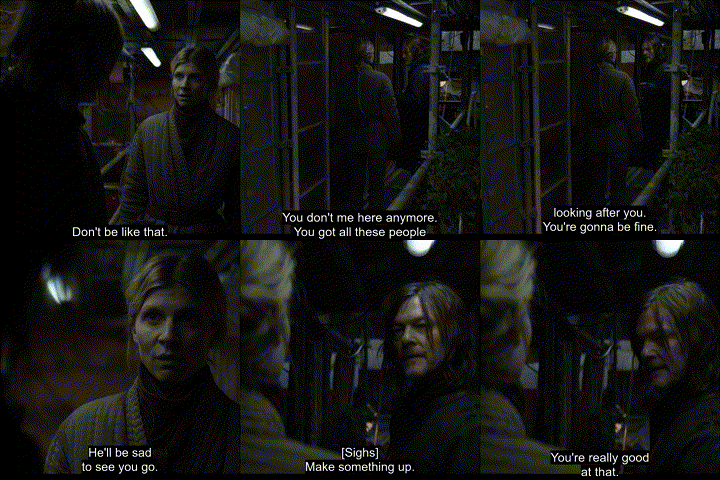
  • Isabelle, yet again, is sacrificing herself for the well-being of someone else by the end of this episode, but we doubt that she will be able to rejoin the ones she loves once Laurent is safe. Isabelle doesn't know that Genet - and perhaps Quinn - is also after Laurent for her own reasons, so she can hardly be blamed for her poorly thought through logic. And although some of us have reservations about where the last two episodes of this season will ultimately go, we're excited for the next one.

⭐⭐🌟Like What We Do? Buy Us a Coffee!🌟⭐⭐

Sunday, October 1, 2023

Paris Sera Toujours Paris |1x03| The Walking Dead: Daryl Dixon

Why miss out?
Subscribe to our blog via E-Mail!

⬇️Listen Now⬇️

⬆️Tap the above graphic⬆️
to listen to this episode
in your favorite Podcasts App


The burdens characters place upon themselves reflects the burden Daryl Dixon carries in his quest to (maybe) find Rick Grimes. The possibility of all these spin-offs converging on a grander narrative is rife. As noteworthy as this episode is, it's somewhat disjointed considering only three episodes of this season remain. Themes of self-reliance vs cooperation and Parisian culture are explored, as Daryl's complex relationship with Carol Peletier is reflected in Isabelle's struggle to return to the turmoil she escaped in Paris. Speculation arises about Isabelle's fate as Laurent's empathetic abilities are scrutinized. Distinctions are drawn between French and American cultural norms. Sylvie's inaction reflects hers and the nuns of The Abbey of St. Bernadette's perspective on mortality: the importance of treating the deceased with dignity and the inherent dangers and desecration of even harnessing the possible utility of the undead. Cultural references, including Maurice Ravel's Bolero, are woven into the discussion as we reflect on Daryl's role as an outsider.
🛑STOP LISTENING! STREAM the unedited version of this podcast, instead! Buying us a ☕coffee on Ko-fi or joining a membership on either Patreon or Ko-fi will grant you immediate access to the uncut version of this discussion, past sessions, and future unedited episode recordings!

David Cameo:
Sherrandy Swift:
Bridget Mason-Gray:

🎖SURVIVORS TIER MEMBERS:
Takeerah:

  • Paris Sera Toujours Paris translates to Paris will always be Paris. Though Dave describes this episode as being all over the place, compared to the previous two episodes - and despite the slow start - much happens. We extracted several nuggets of information and Sherrandy remarks on the amazing visual story-telling.

  • On top of the struggle of attempting to acquire notes so soon after the episode drops on AMC+, Dave reiterates feelings that many people have had over the years with AMC+'s technical issues, with the desktop browser not making the latest episode immediately available at the midnight, Pacific/US time. Sherrandy has stopped staying up until 3am to watch the show because it's typically unavailable for customers with AMC+ on Amazon Prime.
  • Bridget found that this episode was her favorite, so far. Addressing Dave's comments on the disjointed nature of the episode's story, she sees it as more of a ramp-up for more action that will unfold during the remaining episodes of the season. On that note, Sherrandy can't help but mention the classic, TWDU trope: Daryl Dixon arrives at a settlement that is doing well, but is raided and destroyed within 24 hours. By contrast, Daryl leaving behind a recording of himself seems outside the norm of his character; although, he likely didn't expect anyone with malicious intent to be hunting him down.

  • We compare the unusual (to us) transparent and communal nature of Fallou's group to the tight-lipped and suspicious nature of groups in The Walking Dead Universe that we've documented in America for the last decade. We surmise that western civilizations value independence, while cultures abroad prioritize community and helping strangers. It's hard not to remark on how dangerous we perceive Fallou's decision to share so much information with Daryl, even though we know he's trustworthy.

  • This dovetails nicely with Isabelle's comment to Daryl, regarding Laurent's perceived role, about God choosing our burdens: Dave remarks on how it contrasts with the Jean-Paul Sartre / Friedrich Nietzsche existentialist/nihilist expression, We Choose ur Suffering, which emphasizes personal responsibility and freedom to choose over relinquishing/accepting burdens to/from a higher power. Near the end of the episode, as Daryl is about to leave and Isabelle confronts him about it, Laurent cries, I hate both of you, highlighting the extreme forms of these concepts. The discussion explores the balance between self-reliance and cooperation, and the idea that truth can be difficult, however necessary, but belief is inherent in human nature.

  • Sherrandy highlights another theme that runs through this episode: Revolution or coming full-circle. Firstly, The Doors vinyl record (which is circular and revolves around a turntable) is literally seen at Jim Morrison's gravesite. Maurice Ravel's Bolero is somewhat repetitious. While walking through the catacombs, a memorial to The Black Death, Fallou expresses to Daryl that France has survived many apocalypses and the Zombie Apocalypse is no exception. While Daryl is constantly expressing his desire to return to America, Isabelle is forced to return to Paris, coming full-circle to where her post-apocalyptic journey started.


  • Since we touched on The Plague, we discuss how cultural the cultural nature of the French - such as the size of the continent, communal living, and greeting loved ones with kisses on the cheek - contributed greatly to their loses, in contrast to American or even other cultures. The spread of the plague also coincided with a period of significant trade and engagement between North African countries and Europe, which allowed it to spread further on both sea and land, reaching as far as rural communities. Like the zombie apocalypse, there was no escape from the disease, killing a third of Paris, half of France, and 40% of Europe's entire population. Bringing it back to Laurent and how he's seen as the miracle, in light of both The Black Death and TWDU, doesn't being alive in a horrible world make everyone a miracle?

  • We shift our conversation back to the burners. We tried to determine the science behind their existence in the first episode, but we shift to discussing their cause: Sherrandy thinks there are inherent genetic markers present in The French or environmental factors that may have contributed to this variant. Based on the experiment we see in this episode, Dave and a few others attribute their raison d'être to failed experiments conducted by Genet's group, Pouvoir Des Vivants, in their attempt to accelerate the demise of zombies. The use of conducting these experiments on a ship to reduce casualties, which we discussed in the last episode, was most likely a measure they instituted after this failed experiment (which, of course, again, Daryl ruined). The movement of the specific burners we see in this episode appeared jerky and stop-motion-like in some sequences. We attribute this to inadequate CGI and/or the uncanny valley phenomenon, but it was still arresting to witness, none-the-less.

  • The musician we encounter at the start of this episode, whom we've dubbed The Conductor, can be described as mentally unwell and/or completely consumed by his passion for music, as evidenced by his - admittedly impressive - walker orchestra. We immediately recognize how well his behavior suites the episode's title, Paris Sera Toujours Paris - a song by Maurice Chevalier - which reflects the theme of Paris refusing to change, despite apocalyptic events. The Conductor reminds Bridget of the clown from the Twisted Metal series of video games, as another example of mentally unwell individuals consumed by their passion. The school containing the avant-garde art installation Negan and Marshal Pearlie Armstrong encounter in The Walking Dead: Dead City's 5th episode of season one and films, such as Amadeus and Immortal Beloved, are other such examples. There have been creative people across time (who suffer from mental illness) that view their compulsion to create art or music as a calling or a message from God. But, as Sherrandy says, this serves as one of many snapshots of this world's survivors, which gives us a window into their experience - particularly in France; however, we note the similarity of The Conductor's mania to our first encounter with one Juanita "Princess" Sanchez and her vignettes of walkers positioned in various living people situations. Sherrandy also points out that one particular walker that is hung up in the orchestra feels like an homage to The Silence of the Lambs.

  • Maurice Ravel's Bolero is the piece The Conductor orchestrates: the origin of which contains relevance to this scene. Firstly, the obvious observation of the piece being reviled in Europe and wildly accepted in America (thanks to conductor Arturo Toscaninni) is a great parallel to Daryl, a strange American, also finding acceptance in a strange land. During the middle of Bolero's premiere, a woman called Ravel "mad", to which he later remarked, she properly understood it. Whether this was due to Ravel's own pretentious or madness is a point of contention; however, passion and insanity are often familiar bedfellows and The Drama of the Gifted Child by Alice Miller does illustrate one often acts grandiose or depressed when one's self-imaged is challenged.

  • When asked if The Conductor speaks English, he responds to Daryl, Where is Brian? Brian is in the Kitchen. French comedian (who's also done his act abroad in English), Gad Elmaleh, best illustrates the extremely subtle reference to this line's significance by way of a strong routine on how Where is Brian traumatized many French students attempting to learn English in school
    .
  • We take a moment to discuss the events that transpired outside The Conductor's domain: Firstly, the way the gargoyle frames the opening scene prior to them entering the music hall was choice. Second, we focus on Sylvie's inability to shoot the walker seen dragging a corpse shackled to right arm. There seems to be a wild character discrepancy between the murder nun we witnessed in the first episode from her present hesitation in this scene. Initially, Sherrandy and Bridget surmise that she is just a young woman who feels lost in the big open world outside the sheltered confines of The Abbey and is unaccustomed to killing the undead. Dave latches onto the possibility that The Abbey's residents may view the undead as living beings under a spiritual ailment that would lift once Laurent fulfills his destiny as The Messiah. If the latter observation is true, her hesitation stems from the belief that she would be murdering someone who would've eventually be cured. To illustrate, Dave uses The Pope's Exorcist on Netflix: it's the equivalent of harming or killing an innocent child, unresponsible over their actions while being possessed by a malevolent demon. Sherrandy does reiterate, The Abbey's residents have the luxury of believing they can leave lost souls alone because they are safe behind walls and don't constantly have to fight and kill walkers, like the children we met in the last episode.

  • This acts as a great segue to Isabelle asking Daryl to not put down walker Aimée. As Laurent states, earlier on, Daryl acquiescing to Isabelle's request might be partially due to both being good at killing walkers but also her and her people's beliefs on the undead, even if it runs contrary to his instincts. It's a lot like Rick Grimes respecting Hershel Greene's initial demand that he and his people not kill the undead while on his property. The appearance of walker Aimée not only confirms a prediction Dave had about her possible demise - when comparing a scene in the trailer to her first (living) appearance in the second episode - but she was also bitten just after Isabelle left her during the first wave.

  • We end up discussing Jewish burial customs and views on treating dead bodies with dignity, as well as that of The Walking Dead's own Siddiq whose initial philosophy dictated that ending the suffering of the undead was a way to free their trapped souls. The fundamental theme is that the corpses of those who were once alive also have inherent dignity due to them being previously occupied by a soul; however, Bridget and Sherrandy bring up a walker's possible utility, using both the example of Michonne's pet walkers (previously her boyfriend, Mike, and their friend, Terry) and the perpetual motion, bird-box donkey wheel used to extract oil during the refinement process in Fear The Walking Dead's Tank Town during Season 5. Dave, however, reminds everyone that - both on a spiritual and narrative level - walkers, by their very nature, are inherently dangerous, comparing them to Amalek: a malevolent nation in the Bible that was born out of and whose whole existence thrives on hate towards the Israelites. Amalek is the only people God has or will ever instruct the descendants of Jacob to wipe-out from the face of the earth.


  • We discussed Sylvie's inaction against the shackled walkers, but the walkers, themselves, can be seen as yet another examples of the horrible things people have the capacity of doing to one another in this post-apocalyptic hellscape. We do muse on the idea that a Tales of The Walking Dead episode could be concocted based on these walkers appearing, because there has got to be a story there (there doesn't have to be, but a host can dream).
  • Daryl finds a photo-strip of Isabelle and Quinn in a book of Arthur Rimbaud's Poésies Complètes (Complete Poems) which is interesting because the actress's who plays Isabelle is named Clémence Poésy (whose name literally translates to Clemency and Poetry). Dave does bother to check what is on Page 23, but it's just a note to the editor.

    Editor's Note, pun not intended: What's actually on page 23 is the beginning of a poem called Les Premières Communions (The First Communion). The first two verses go as follows, translated from French:
    • Truly, they’re stupid, these village churches
      Where fifteen ugly chicks soiling the pillars
      Listen, trilling out their divine responses,
      To a black freak whose boots stink of cellars:
      But the sun wakes now, through the branches,
      The irregular stained-glass’s ancient colours.
    • The stone always smells of its earthly mother.
      You’ll see masses of those earthy rocks
      In the rutting country that solemnly quivers,
      And bears, on ochrous paths, near heavy crops,
      Those burnt shrubs where the sloe turns bluer,
      Those black mulberries the hedge-roses top.
    • [for the rest of the poem, tap either of the of the following to read in either French or English - these words are simply what's on Page 23]
  • Sherrandy and Bridget laugh about the fact that it appears that Daryl doesn't actually open the book to be able to tell what page Isabelle was on (23), jesting that he must have a savant-like ability to count pages without actually looking. It seems that Isabelle does have a thing for guys with long hair(?). Semi-seriously, Bridget does compare their interaction to a relationship between two teenagers whose courtship is rooted in manufacturing drama for one another: Daryl is trying to play it cool by pretending to only care about what page he's on, while actually (but probably not really) burning with jealousy over this other man she's with in the photo, while Isabelle has been seen calling Daryl out for wanting to leave so soon in both the end of this episode and the middle of the last - in bed, wink, wink. Dave also offers an alternative point of view: they could just be seen as siblings bickering. Their dynamic does somewhat reflect that of Daryl & Carol Peletier: the latter could've turned into a relationship, but too much time has passed and they view one another as gross, while the former thrives on passive-aggression and jealousy. Just to be clear, we're not being serious and don't wholly believe that: these are just funny thoughts we have to amuse ourselves.

  • At first glance, Sherrandy and Bridget bristle at what they perceive is a look of judgement towards Isabelle as Daryl witnesses her gathering up the remnants from her pre-apocalypse life in the form of drugs (to use as currency for information on the radio), which would be ironic considering the first time we meet Daryl and his brother, Merle Dixon, on TWD, they were hoarding blue meth and other addictive substances. Dave points out that maybe Daryl's look is less judgy and more arresting: up until this point, Daryl was in constant pursuit of a radio, at the expense of everyone else's needs (and, also, both Fallou & The Conductor's nutty responses, like Paris is crying). When Daryl sees the pills, he may have started connected a long trail of dots (suicide-scars, ex-boyfriend, and now drugs) that constructs a bigger picture of the turmoil Isabelle might've left behind, pre-apocalypse, and that his persistence has forced her to confront a troubled past. What completes the portrait is discovering, later on in the episode, that her ex-boyfriend, Quinn (now owner of the Demimonde: the bohemian night club whose entrance is through the Black Plague catacombs), is alive and "reminds" Isabelle the terms: Ed Peletier was constantly reminding Carol of the terms in the first season of TWD.

  • Daryl, of course, puts it all together and insists that information on a radio is not worth Isabelle being beholden in any way to Quinn. But also, in true Daryl fashion, he decides that he's caused enough trouble for Isabelle and tries to slip out of Fallou's compound before he puts she or anyone else in danger. The conversation suddenly shifts to the audience's (lack of) desire for Daryl to be in a romantic relationship with Isabelle. Though we understand why people try to `ship, we're ambivalent about it happening, considering the genre. It might also be pointless, considering Isabelle might die, leaving Daryl responsible for keeping Laurent safe, since she isn't present in the title sequence where Daryl & Laurent are overlooking Mont Saint Michel in the distance.

  • Bridget is amused with Laurent's display of emotional intelligence, spotting a grieving woman named Sonia whilst readily accepting alms. Dave focuses a little on his readiness to accept gifts from his parishioners, stepping into his role with too much ease, which reminds Sherrandy of Harry Potter being overwhelmed by the initial attention he received from others who first met him (as the boy who lived). After all, Laurent has been told that he is special since he was born, but it's only now that this belief is being validated by Fallou's community. Bridget compares Laurent's near-supernatural empathic ability to an episode from the television series called Lie to Me, where a character's trauma leads to heightened emotional perception. Laurent may have a combination of spiritual and biological factors contributing to his empathetic abilities, a bridge that might be too far for some people to accept (which also might lead to witnessing another child's death, which nobody wants).

  • We focus on the presence of a French adaptation of The Doors' People are Strange and how, among all the playwrights, poets, and other creative French figures Daryl is completely unfamiliar with that are buried in the cemetery they are walking through, Daryl points out the one thing that isn't strange to him (though strange to see in such an unfamiliar setting): the grave of Jim Morrison. Bridget gives us a ton of background about how Jim Morrison ended up being buried in France and it has a lot to do with his struggle and failure to free himself from drug and alcohol abuse. We made note of the flowers on his grave, which Dave thought to be plastic; however, since immediately after that scene we witness Fallou burying two members of his community, it's easy to surmise that anyone of them or someone from another community might be honoring the former rock legend. Jim Morrison's epitaph, ΚΑΤΆ ΤΟΝ ΔΑΊΜΟΝΑ ΕΑΥΤΟΎ, translates (from Greek) to the one who fights his own demons.


  • It's pretty obvious that People Are Strange is meant to be representative of Daryl's character being a stranger, but Daryl is obviously just as strange to others as they are to him. American culture is also not as welcoming to strangers as much as cultures abroad. Audiences that have been critical of this series will sometimes misunderstand the openness of Fallou's group as poor writing, instead of merely a clash of cultural norms.
  • While walking in the cemetery, Laurent attempts to regale Daryl about Jean de la Fontain's La mort et le bûcheron (Death and The Lumberjack). On its face, Daryl can easily be seen as the lumberjack, since he is seen constantly complaining about getting to a radio. But Dave thinks it better describes Isabelle, since the aged lumberjack's first line in the fable is, what pleasures have I taken, in life? Although Isabelle was a former party girl, it seemed more out of necessity than pleasure: what little drug use she had partaken in was more of a way to cope with, rather than enjoy her life. Add to that the burden of having to take care of two children: her sister, Lily, after their parents died and Laurent, after Lily died. And while we often recognize that TWDU is a chance to relinquish one of their burdens, Isabelle is ready to put those heavy burdens on again with Quinn, just like the lumberjack, just so Daryl can finally call home.

  • During their walk through the cemetery, Daryl sees Pouvoir Des Vivants' logo graffitied on a car and asks what they are about, to which Isabelle responds that they were a group that started right after the fall with the hope of establishing order and ending the zombie apocalypse. Daryl compares this to L'Union de L'Espoir's mission of hope, with Laurent as their messiah. Dave thinks the comparison is apt, since people often appeal to both authority and faith to achieve a sense of order in their lives. While Bridget recognizes that Catholicism does offer a path to salvation (from original sin), as a Protestant, salvation is freely given in exchange for merely accepting Jesus as your savior. Protestantism focuses on the individual's relationship with God rather than through the church: the whole reason for Martin Luther's separation from the Catholic Church because, although people were reciting the words, along with a majority of folks being illiterate, most of those who could read the Latin words still didn't understand them. The Protestant movement immediately gained momentum after the invention of the Gutenberg Press, which sparked several linguistic translations, spreading the gospel across the globe.

  • We take a hard look at Stéphane Codron's first encounter with Genet: the former, we learn, is ancillary involved with the latter, whom we can now confirm is the leader of Pouvoir Des Vivants. Although we see Codron is very determined to catch Daryl, the experiments he witnesses being conducted - both on the way in and on the way out of his meeting with Genet - might reveal to him that there may be a bigger threat that will shift the his focus away from seeking vengeance. We make some jokes about the raw deal Codron got from joining PV by only getting a face tattoo, while Genet is smoking-up the good stuff. His face tattoo does remind us of George Clooney's character, Seth Gecko, in the movie From Dusk Till Dawn. John Esposito was co-producer and writer for both that film and the early webisodes of The Walking Dead. Regardless, many cultures express their cultural and religious beliefs through tattoos, like the Māori from New Zealand.

  • Speaking of sparking up, we take a moment to muse on Genet's fishbowl of lighters and matches, which is fitting when you consider both their logo and how their group is often compared to The Civic Republic (Military), whose favorite expression is We are the last light of the world. Bridget reminds us that the president of New Babylon Federation - whom we dubbed Smokey, at the time - was also seen lighting up a cigar when we first meet her on screen during the Season One finale of Dead City. While Dave briefly expresses a brief annoyance with cigar afficionados, Bridget expresses her annoyance with beer snobs. She quickly noticed that her remarks might've been a slight towards Dave's friend, Chris, who hosts a channel called On Tap, so she launches into a rant about how Party Bridget was a cheap-beer-drinking hipster. Sherrandy quickly pivots by asking whether Genet was smoking tobacco or marijuana and how harvesting either would've been a great excuse to ship heaps of it from The United States back to Europe.
  • Sherrandy, on a more serious note, has no sympathy for Stéphane and his parents desire for him to protect Michel Codron, since he's avenging the loss of a brother who was effectively a rapist. Still, she wonders if his and Isabelle's stories correlate and whether it could be a point of understanding between them. Either way, they may both be gunning for Quinn in the coming episodes, all things considered. But, speaking of connection points, although we mentioned that there's an obvious connection between Daryl losing his brother, Merle, and Stéphane losing his brother, Michel, we didn't quite articulate their significance. Under the backdrop of announcing the new game (in development) called The Walking Dead: Destinies (which takes the player through several what-if scenarios as a result of key plot-points changing, like Rick dying in his final confrontation with Shane Walsh, instead), it's interesting to recognize that Stéphane is the result of what would've happened had Merle lived, rather than Daryl. Maribelle is still in play - Michel's actual murderer - so Codron has the ability to seek the truth change his course (as well as how we perceive him) in this series.

  • Of course, we can't not comment on how silly it looked to watch Daryl helplessly standing still on a cracking rooftop, below his feet, eventually falling through it. Bridget and Dave didn't think anything of it, as they compare it to when you are on a frozen lake and the ice breaks, you should limit your moments to prevent yourself from falling through it. This is contrary to when you are caught in an undertow or riptide, where you should actually swim parallel to the shore to get out of it (not do nothing, much to Dave's surprise). Tangent: Sherrandy relays a true story about a little girl in a unicorn raft being suddenly whisked away by the currents, found alive hours and miles away later by a fishing boat.

  • 🎖️SURVIVORS Tier Member, Takeerah, who was previously in the chat, now joins us on screen as we briefly discuss the song, as sung by character Anna Valery, Le Temps de l'Amour by Françoise Hardy. The song is about living life, having adventures, and loving optimistically while one is young; although love is ever-present, we love differently as we get older. Our characters' pasts is seen as a burden or curse, affecting their present lives: will TWDU be their chance to live life to the fullest? Take for instance, Laurent, who is amazed by his experience in The Demimonde and slowly opening up to how this world actually works: both he and Sylvie have never experienced a nightclub, let alone seen one on TV or in a movie. How will this affect them, moving forward, especially with Sylvie's first flirtation experience with Emile.
  • Isabelle's dishonesty is seen as the cause to many of the problems Daryl experiences on the show, though Daryl discovering Isabelle's drugs, meeting her (possibly) abusive ex-boyfriend, and the knowledge of her suicide attempt does make him sympathetic towards her. Still, whether it's sibling bickering or a lover's quarrel, Takeerah thinks they seem to like each other less the more they interact. This triggers Bridget into recalling her childhood arch-nemesis, Karl, who annoyed her so much while in elementary school. Her mom suggested that her annoyance was a thin line between hate and love, but still can't stand Karl to this day. Dave suggests that her mom might be right and Bridget tacitly acknowledges that her husband, like Karl, was also in the academically gifted program. Bridget also acknowledges that holding grudges is wasted energy and very ungodly.

  • Dave reminds everyone that the experiences of Daryl's travel companions reflect his greater, back door plot: the possibility that the entire reason he got into this mess was the dogged pursuit of finding Michonne and Rick. Daryl may be realizing he, too, has placed the burden of finding them onto himself much in the way Isabelle had (and was ready to again) with Quinn. Sherrandy is skeptical, reminding us that it's not explicitly stated that he went looking for Rick & Michonne. Others suggest that Rick had already come home, but Dave reminds them that it would've been too soon, since TWD's series finale clearly occurs 13 years after the fall and, at least in France, they state that it's 12 years after the fall. Never-the-less, it feels like all these spin-offs will either converge in the upcoming The Walking Dead: The Ones Who Live spinoff or a new spin-off or feature film that brings all prior events to an even more grand crescendo. To which many jokes are made at the expense of Rick's poor leg (it's a background noise thing: you had to be there).

  • Special Editor's Note: Linda and I had a very great exchange by way of a thread of comments on the video of this episode posted on our YouTube channel. She expressed that it's a crime that more people didn't recognize the significance of Antoine (the carrier pigeon guy) naming his favorite pigeon Zizou: nickname of legendary French footballer, coach, and philanthropist, Zinedine Zidane.

⭐⭐🌟Like What We Do? Buy Us a Coffee!🌟⭐⭐